The Invisible Map: How Territory Writes the Soul of Humanity
Thalia Marin
Reading time: 5 minutes.
Mar 5, 2026
Welcome to The Atlas Project Journal, your space for cultural insights and research.
To begin with the journey...
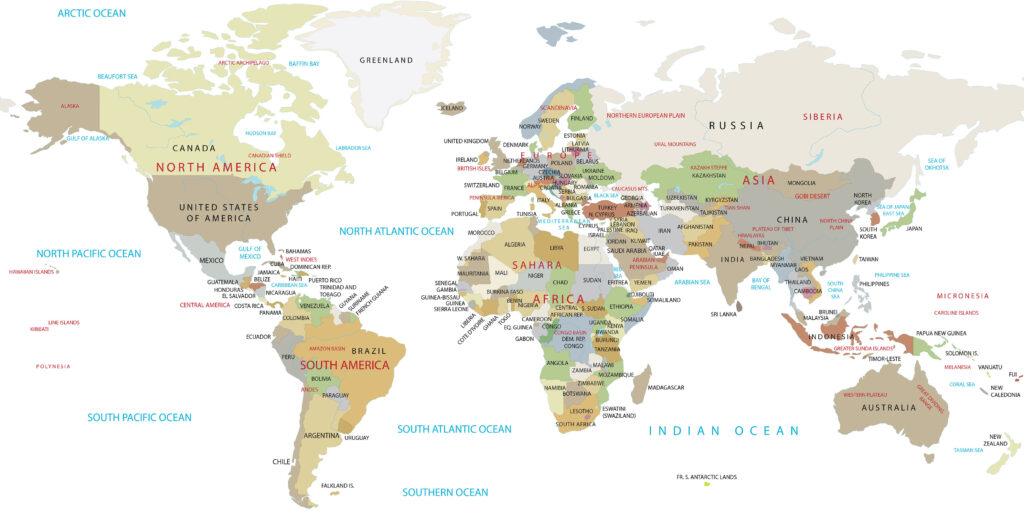
Take a look at a map. To a casual observer, it is a collection of ink, lines, and names. But to those who look closer, those lines are not just borders; they are scars, treaties, and the echoes of ancient footsteps.
Why did some civilizations flourish in the desert while others vanished in fertile valleys?
The answer lies in a silent, millennia-old dance: History and geography are inseparable. One is the stage; the other is the performance.
The Stage Defines the Play: Geography as Destiny
Geography does more than suggest where a border should lie; it deeply influences the collective thought, spiritual life, and social structures of the people within it. We are, in many ways, a reflection of the soil we walk upon.
Core pillars
Spiritual Landscapes: The vast, silent horizons of the desert often sparked monotheistic spiritualities, while the lush, unpredictable jungles of Southeast Asia fostered beliefs in a multitude of spirits and cyclical rebirth.
Social Structures: Wide, open plains often led to nomadic or highly mobile societies, whereas protected valleys encouraged the development of dense, fortified city-states.
Philosophical Outlook: Maritime cultures, living on the edge of the infinite sea, naturally developed philosophies of openness, exploration, and trade.
The River Logic and the Migration of Art
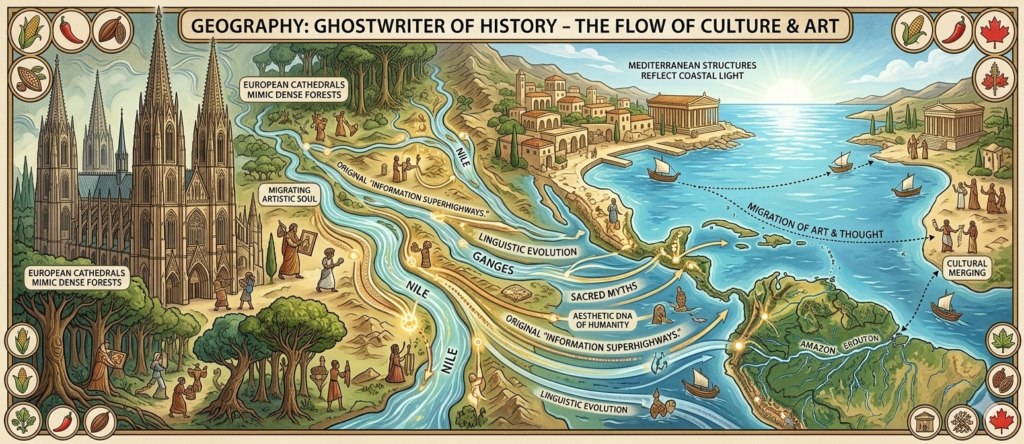
Rivers like the Nile, the Ganges, and the Amazon have served as the original “Information Superhighways.” They were the cradles of not just trade, but of sacred myths and linguistic evolution. Through these arteries, the “aesthetic DNA” of humanity was exported across nations.
When we look at Art, we see the land. The soaring Gothic cathedrals of Europe mimic the verticality of dense forests, while the horizontal, sun-drenched structures of the Mediterranean reflect the clarity of the coastal light. As cultures migrated along geographic corridors, they didn’t just carry goods; they carried their artistic soul, blending it with every new territory they reached.
Culinary Geography: The Export of Identity
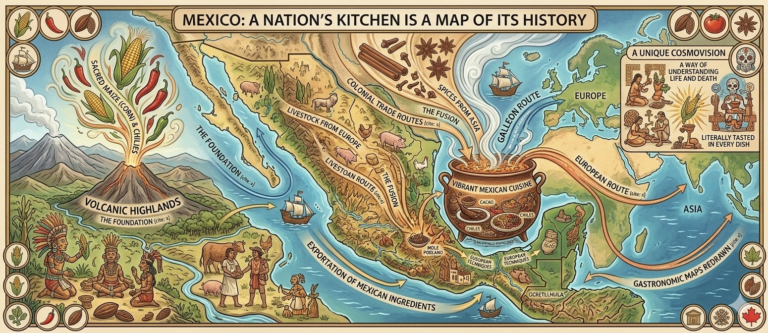
Perhaps the most tangible connection between land and culture is Gastronomy. A nation’s kitchen is a map of its history. While ingredients are the results of local geography, recipes are the results of historical movement.
Look atMexico: its vibrant culture and culinary history are a masterclass in geographic syncretism. This land is a perfect example of how territory dictates flavor:
The Foundation: The volcanic highlands provided the sacred maize (corn) and chilies.
The Fusion: History brought spices from Asia and livestock from Europe via colonial trade routes.
The Result: A unique cosmovision, a way of understanding life and death, that is literally tasted in every dish. The exportation of Mexican ingredients, like cacao and tomatoes, redrew the gastronomic maps of the entire world.
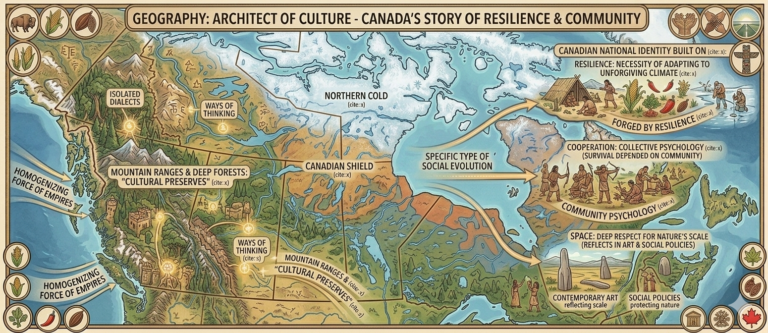
Mountain ranges and deep forests did more than protect territories; they acted as “cultural preserves.” They isolated dialects and ways of thinking from the homogenizing force of neighbouring empires.
We can see this in the rugged landscapes ofCanada. The vastness of the Canadian Shield and the northern cold forced a specific type of social evolution. In Canada, geography forged a national identity built on:
Resilience: The necessity of adapting to an unforgiving climate.
Cooperation: A collective psychology where survival depended on community rather than isolated individualism.
Space: A deep respect for nature’s scale that reflects in their contemporary art and social policies.
Modern Echoes: Navigating the Human Story
We often think that in our digital age, the physical land no longer matters. Yet, our “modern” identity is deeply rooted in this Historical Geography. The way a society speaks, its social hierarchies, and even its contemporary laws are ghosts of how its ancestors adapted to their surroundings.
Modern geopolitics is frequently just the shadow of ancient geography. To understand today’s global landscape, you don’t just need a news feed; you need a lens that reveals how the evolution of a territory shaped the psychology of its nation.
A Global Perspective on Territory
In conclusion, the world is not a collection of isolated names; it is a profound connection between territory, time, and culture. Understanding this link is the first step toward true global empathy. By understanding the “where,” we finally begin to comprehend the “why” behind the diverse ways of living and thinking that define our shared humanity.
This expedition is only just starting. Keep exploring The Atlas Project to uncover the next chapter of how our world’s rugged landscapes continue to write the future of culture.
Thalia Marin
Mar 5, 2026
Next Entry
Current Entry
Join the expedition
Subscribe to our Newsletter
About the project
“The Atlas Project is a visual and sensory encyclopedia designed for the modern explorer.
Our mission is to go beyond conventional maps, tracing the essence of humanity through the profound connection between territory, time, and culture.
We invite you to discover the footprints that define us.”